


Beyond the Mould: How Value-Added Operations Turn Components into Finished Products
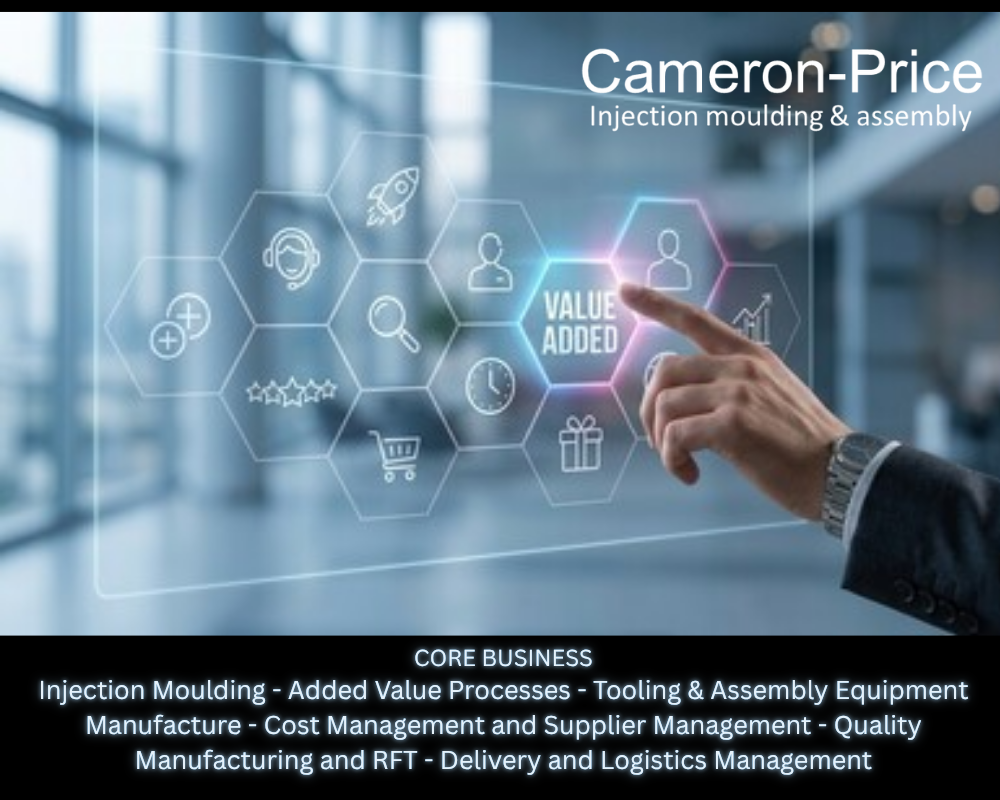
Moulding a component is rarely the end of the job. Most products need parts joined, assembled, tested and packed before they are ready to ship, and every one of those steps is a chance for something to go wrong or for a handover to slow things down.
Value-added operations bring those steps under one roof. Instead of a moulder making parts and someone else finishing them, the same partner takes a project from moulded component through to finished, tested product ready for delivery.
Why what happens after moulding matters
A perfectly moulded part still has to become a working product. That often means joining several components, adding inserts or fixings, checking that the finished item performs, and packing it for despatch.
Splitting that work across different suppliers adds cost, time and risk. Parts travel between sites, quality is harder to control, and problems are easy to miss when no single supplier owns the whole job. Keeping moulding and the steps that follow together removes most of that friction.
Assembly and joining
Assembly is where individual mouldings become a single product. Cameron-Price offers value-added operations that include customised assembly across a wide range of products, from consumer goods to household items.
Joining plastic parts reliably takes the right method for the job. A range of welding techniques covers different needs, including ultrasonic, linear vibration, laser, spin and hot plate welding, each suited to particular materials, joint types and strength requirements. The right choice gives a clean, strong join that holds up in use.
Testing and safety-critical work
For many products, especially those with a safety role, a join is only acceptable if it can be proven. This is where testing earns its place.
Pressure testing and full functional checks confirm that an assembly does what it should before it leaves the building. For complex, safety-critical assemblies, that testing is part of the build rather than an afterthought, so every unit is verified rather than sampled. It is the difference between hoping a product works and knowing it does.
One supply chain, fewer handovers
Beyond the physical work, there is real value in one partner managing the flow from start to finish. Cameron-Price manages the supply chain from design to delivery, with integrated inventory and stock levels matched to production schedules, so components arrive when they are needed.
This matters more than it sounds. Fewer suppliers means fewer points of failure, clearer accountability and a steadier supply of finished product. It also frees up time that would otherwise be spent coordinating between several companies.
Quality that runs through the whole job
When moulding, assembly and testing sit together, quality can be built in at every stage rather than checked only at the end. The same standards that apply to the moulded part carry through to the finished assembly. That consistency is part of Cameron-Price’s wider focus on quality and performance, and it shows in work like the power steering assembly projects, where moulded parts, joining and testing all come together in one place.
A complete route from component to product
Treating value-added operations as part of the moulding job, rather than a separate stage, gives a simpler and more reliable path from idea to finished product. If you have a product that needs more than moulding alone, the team at Cameron-Price can take it through assembly, testing and delivery. Get in touch to talk through what your project needs.